
Challenge
Communication becomes difficult when professionals and individuals do not share a common language. This can lead to misunderstandings, incomplete information, and difficulties conveying essential needs.
AI-Powered Multilingual Communication Platform
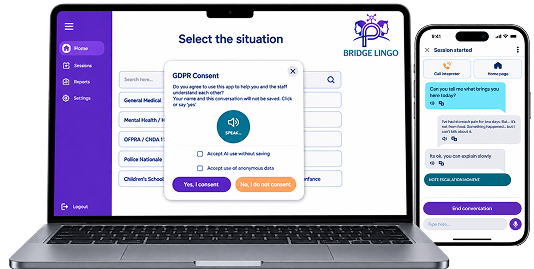
AI Chat is an AI-powered multilingual communication platform designed to bridge language gaps between professionals and individuals who face difficulties communicating in the local language.
Developed to support healthcare providers, legal professionals, and social service organizations in France, the platform addresses the communication challenges faced when interacting with non-French-speaking migrants and refugees.
What is AI Chat?
AI Chat is an AI-powered multilingual communication platform designed to bridge language gaps between professionals and individuals who face difficulties communicating in the local language. Developed to support healthcare providers, legal professionals, and social service organizations in France, the platform addresses the communication challenges faced when interacting with non-French-speaking migrants and refugees.
Through speech recognition, multilingual translation, and voice-based interaction, AI Chat facilitates more accessible and effective communication. By combining AI automation with human oversight, the platform aims to promote responsible, culturally sensitive, and inclusive interactions.
Addressing Communication Barriers In Critical Services
Communication becomes difficult when professionals and individuals do not share a common language. This can lead to misunderstandings, incomplete information, and difficulties conveying essential needs.
Access to reliable translation services across different languages can be limited. Professionals need an accessible solution that enables effective communication with individuals from diverse linguistic backgrounds.
Relying entirely on automated communication can create risks when conversations involve complex or sensitive information. Human intervention is essential to support responsible communication and address situations that require additional assistance.
Traditional translation methods can interrupt the natural flow of conversations. In time-sensitive environments, delays in understanding and responding can affect the overall communication experience.
Not every individual is comfortable reading or writing, particularly when communicating in an unfamiliar language. This creates a need for more accessible, voice-based, and visually supported interactions.
Direct translations may fail to capture the intended meaning, context, or cultural nuances of a conversation. This is particularly important in sensitive healthcare, legal, and social service interactions.
Making Communication More Accessible, Inclusive & Efficient
Enabled communication across 60+ languages, helping bridge language gaps between professionals and individuals.
Introduced voice-based and text-based interactions to accommodate different communication needs and literacy levels.
Integrated speech recognition and translation capabilities to support smoother multilingual conversations.
Simplified interactions through intuitive icons, body charts, and visually supported interface elements.
Combined translation and language mapping capabilities to support communication across diverse linguistic backgrounds.
Implemented AI-to-human escalation to support complex and sensitive conversations requiring human intervention.
Integrated text-to-speech and silence detection capabilities to support more natural voice-based communication.
Brought AI-powered language technologies and human oversight together to support more inclusive healthcare, legal, and social service interactions.
Reduced reliance on traditional translation methods by bringing speech recognition, translation, and voice interaction together in one platform.
Combined automated language processing with human oversight to support safer, more reliable communication in sensitive service environments.